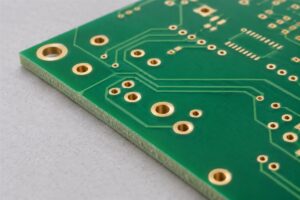
Purple Circuit Board: Solder Mask, Quality, Cost, and DFM Guide
“Choose purple because it looks premium” is incomplete advice. Purple can give a product a recognizable identity, but the color itself does not improve conductivity, signal integrity, or reliability. If the fabrication note says only “purple PCB,” purchasing and CAM still have several unanswered questions—and those questions are where color mismatches, delayed builds, and disappointing silkscreen usually begin.

Direct Answer: What Is a Purple Circuit Board?
A purple circuit board is normally a PCB coated with purple solder mask over its copper circuitry. The underlying board may still be standard FR-4, and its electrical performance depends on the laminate, stackup, copper geometry, surface finish, and qualified solder-mask system—not on the purple pigment alone. Specify the exact mask, finish, inspection criteria, and acceptable color variation before production.
1. Do Not Confuse Board Color with Board Construction
The visible purple layer is usually a liquid photoimageable solder mask. It protects conductors, defines openings around pads, and provides electrical insulation under specified conditions. It is not the core material and it is not the metallic finish on exposed pads.
| Visible feature | What it usually is | What it does not prove |
|---|---|---|
| Purple field | Cured solder mask | FR-4 grade, Tg, copper weight, or impedance |
| Gold-colored pads | Often ENIG, but verify the fabrication note | That every purple board uses ENIG |
| White markings | Silkscreen or legend ink | Component accuracy or assembly quality |
| Darker and lighter purple areas | Copper pattern showing through, coating variation, or lighting | Automatically a process defect |
OSH Park is a familiar example: its standard two-layer service combines purple solder mask with FR-4 and ENIG. That is a particular service stack, not a universal definition of a purple PCB.
2. Purple Does Not Make the PCB Electrically Better—or Worse
This is where online discussions often go sideways. One person associates purple with a favorite development board; another assumes non-green mask is lower quality. Neither conclusion follows from color alone.
| Performance question | What actually controls it | Purple-mask action |
|---|---|---|
| Trace resistance | Copper thickness, width, length, and temperature | No special action beyond normal copper control |
| Controlled impedance | Stackup, dielectric properties, trace geometry, and mask model | Tell the field solver whether mask covers the trace |
| Solderability | Pad finish, storage, cleanliness, and assembly process | Specify the pad finish separately |
| Insulation and durability | Exact cured mask chemistry and qualification | Approve the material system, not just “purple” |
| Thermal behavior | Copper distribution, laminate, vias, airflow, and power loss | Do not use color as a thermal specification |
For exposed or solder-mask-covered high-speed structures, the mask layer can influence impedance. The relevant inputs are thickness and dielectric behavior of the actual material. “Purple” is not a usable field-solver parameter.
3. Decide Why You Want Purple Before Sending the RFQ
Purple is useful when it solves a product problem. It can distinguish a board family, support brand recognition, or make prototypes easy to identify. It becomes expensive when the team treats a visual preference like an undefined engineering requirement.
| Goal | Sensible specification | Common mistake |
|---|---|---|
| Brand identity | Approved color reference plus gloss/matte requirement | Expecting every supplier’s “purple” to match |
| Prototype recognition | Purple on both sides, normal supplier color tolerance | Paying for a cosmetic master sample unnecessarily |
| Product revision control | Revision text, barcode, serial, or data-matrix marking | Using color as the only revision indicator |
| Assembly contrast | Confirm legend color and inspection performance on a sample | Assuming white legend is equally readable on every shade |
| Mixed-board production | Document color per part number in the drawing and PO | Relying on filenames or email instructions |
A good first question is simple: must the shade match a branded enclosure, or does any recognizable purple work? Those are very different purchasing requirements.

4. Treat “Purple” as a Material and Process Selection
Commercial purple solder masks exist. Taiyo America, for example, lists purple among the colors available in its PSR-4000 BN Series, and its multicolor PSR-4000 PRSM data identifies purple as an available option. That proves availability, not automatic compatibility with every PCB factory, exposure system, surface finish, or reliability program.
| Qualification item | What to request | Why it matters |
|---|---|---|
| Material identity | Manufacturer and product series, or approved equivalent | Pigment name alone says little about performance |
| Applicable qualification | Current evidence for the required IPC-SM-840 class/specification | Qualification attaches to the system and process |
| Surface-finish compatibility | Confirmation for ENIG, immersion tin, HASL, or the selected finish | The mask must survive downstream chemistry |
| Assembly compatibility | Lead-free process and expected thermal exposure | Reflow can change appearance or expose weak cure |
| Special environment | Outgassing, humidity, chemical, UV, or temperature requirements | Standard decorative color approval may be insufficient |
IPC describes solder mask as a permanent protective coating and maintains IPC-SM-840 as the qualification and performance specification for permanent solder mask and flexible cover materials. Ask which exact product and process are qualified. Do not accept “IPC compliant purple” as the end of the conversation.
5. Expect Color Variation Unless You Define a Control Method
CAM can verify apertures and registration, but it cannot turn a vague color adjective into an objective acceptance limit. A purple board may look different over copper pours and bare laminate because many solder masks are not perfectly opaque. Cure, coating thickness, surface texture, photography, and viewing light add more variation.
| Source of variation | What you may see | Practical control |
|---|---|---|
| Copper below the mask | Darker zones over planes or dense routing | Review representative artwork, not a blank color chip only |
| Coating thickness | Local shade or gloss variation | Keep the qualified coating process and acceptance criteria stable |
| Cure and assembly heat | Shift in shade or gloss | Approve samples after the relevant thermal cycle when appearance is critical |
| Matte versus gloss | Large perceived color difference | State the finish explicitly |
| Lighting and camera settings | Sample photos that do not match physical boards | Approve under defined lighting or use a physical golden sample |
| Supplier/material change | Lot-to-lot or source-to-source mismatch | Require notification and requalification for cosmetic products |
If appearance is customer-facing, approve a production-representative coupon or golden board. A monitor screenshot, Pantone reference, or phone photo can guide discussion, but it does not reproduce a translucent cured coating over patterned copper.
6. Check Inspection and Silkscreen Before Committing
Green is common partly because factories have extensive process experience with it. A purple circuit board can still inspect well, but the combination of mask shade, legend ink, copper image, lighting, and AOI recipe must be evaluated together.
| Inspection concern | Risk | Better action |
|---|---|---|
| Mask opening registration | Encroachment on pads or insufficient dams | Verify the fabricator’s mask registration capability |
| Fine-pitch dams | Slivers may break or be removed by CAM | Ask for minimum producible dam by color/process |
| White silkscreen | Low contrast on pale or glossy purple | Review a representative legend sample |
| AOI recipe | Thresholds optimized for another color may misclassify features | Confirm the factory has validated purple-mask inspection |
| Manual rework | Dark mask may hide fine traces and residue | Provide drawings/test points; do not rely on visual tracing |
| Via tenting | Incomplete coverage or trapped-process concerns | Call out tented, plugged, filled, and capped vias correctly |
This is a real community pain point: designers pick a color at checkout, then discover that a fine mask dam, tiny legend, or tented via does not look like the rendering. The rendering is not a process capability statement.

7. Put the Right Notes in the Fabrication Package
Do not put critical color requirements only in the order portal. The drawing, readme, and purchase order should agree. During a PCB manufacturing engineering review, CAM needs requirements that can be checked against actual files and process limits.
| Fabrication-note field | Example of a usable instruction |
|---|---|
| Solder-mask color | Purple, both sides |
| Material/process | Supplier-qualified LPI system; disclose product series |
| Texture | Gloss, matte, or supplier standard |
| Color control | Cosmetic match not required, or match approved golden sample |
| Legend | White, both sides; no printing on exposed pads |
| Surface finish | ENIG, HASL, immersion silver, or the project-specific finish |
| Mask features | Openings defined by Gerber/ODB++; minimum dams subject to DFM approval |
| Via treatment | State each required type using unambiguous fabrication terminology |
| Change control | Notify customer before mask manufacturer/product substitution |
The color note does not replace Gerber solder-mask layers. Those layers should describe where the mask is absent; the drawing describes the material, color, texture, and acceptance intent.
8. Control Cost and Lead Time Without Guessing
Purple can cost the same as a standard color at one supplier and trigger a special batch at another. The difference is not proof of quality. It usually reflects stocked material, panel batching, cleaning/changeover, minimum order quantities, and scheduling.
| Cost/lead-time driver | Question to ask before release | Decision implication |
|---|---|---|
| Stocked purple process | Is purple run routinely on this construction? | Routine production usually carries less scheduling risk |
| Minimum batch or panel | Is there a surcharge or minimum quantity? | Combine demand only if revision control remains clear |
| Prototype-to-volume transfer | Will volume use the same mask product and finish? | Reapprove appearance if the process changes |
| Color tolerance | Is cosmetic matching included in the quote? | Tight matching needs samples and acceptance rules |
| Scrap/rework limits | Are cosmetic criteria stricter than functional criteria? | Separate Class/functional defects from cosmetic preferences |
Before locking the BOM and enclosure color, request PCB fabrication and assembly support with the intended volume, finish, cosmetic requirement, and delivery target. A low prototype price does not guarantee an identical mass-production supply chain.
9. Use This Purple PCB Release Checklist
Save this table. It catches most of the expensive ambiguity before CAM starts tooling.
| Release check | Pass condition | If it fails |
|---|---|---|
| Purpose defined | Branding, identification, or cosmetic intent is documented | Reconsider whether purple is necessary |
| Exact construction defined | Laminate, stackup, copper, finish, and mask are separate fields | Complete the fabrication drawing |
| Purple availability confirmed | Factory identifies an available qualified material/process | Select an approved alternative or adjust schedule |
| Shade acceptance defined | Supplier standard or physical golden sample is named | Do not reject boards by an unstated expectation |
| Fine features reviewed | Mask dams, clearances, BGAs, vias, and legend pass DFM | Modify data or approve documented CAM changes |
| Inspection plan confirmed | AOI/manual criteria work with the selected color | Build a qualification lot first |
| Thermal/RF needs checked | Actual mask properties are included where relevant | Obtain the material data and rerun analysis |
| Revision identification independent | Part number, revision, and traceability markings are present | Add machine-readable and human-readable identifiers |
| Files and PO agree | Color, side, finish, and texture match everywhere | Resolve conflicts before release |
For a production design, submit the full package for a CAM and DFM review rather than asking whether “purple is available” in isolation. The correct answer depends on the mask openings, construction, quantity, qualification level, and cosmetic tolerance.
Frequently Asked Questions
Is a purple circuit board made from a different substrate?
Usually no. Many purple boards use ordinary FR-4 with purple solder mask. Ceramic, flex, high-frequency, and other substrates can also receive specialized coatings, so verify the stackup instead of inferring it from color.
Does purple solder mask affect signal integrity?
Color alone is not the controlling variable. For solder-mask-covered high-speed traces, model the thickness and dielectric properties of the actual cured mask system when the tolerance requires it.
Why are some development boards purple?
Purple is visually distinctive and can function as brand identity or quick product-family recognition. That marketing choice does not define the board’s electrical specification.
Is purple solder mask more expensive than green?
It can be. Cost depends on whether the fabricator stocks and routinely runs the material, plus batch size, changeover, finish, quantity, and color-matching requirements. Ask for the real production route.
Can I specify a Pantone number for a purple PCB?
You can use it as a communication reference, but it may not be enough for acceptance. The cured mask sits over patterned copper and has its own opacity and gloss. For critical appearance, use a production-representative golden sample and defined viewing conditions.
Final Takeaway
A purple circuit board is a valid engineering and branding choice, but “purple” is not a complete PCB specification. Separate color from laminate, copper, finish, qualification, inspection, and impedance requirements. Then define whether you need supplier-standard purple or a controlled cosmetic match. That small distinction prevents a surprising amount of rework.